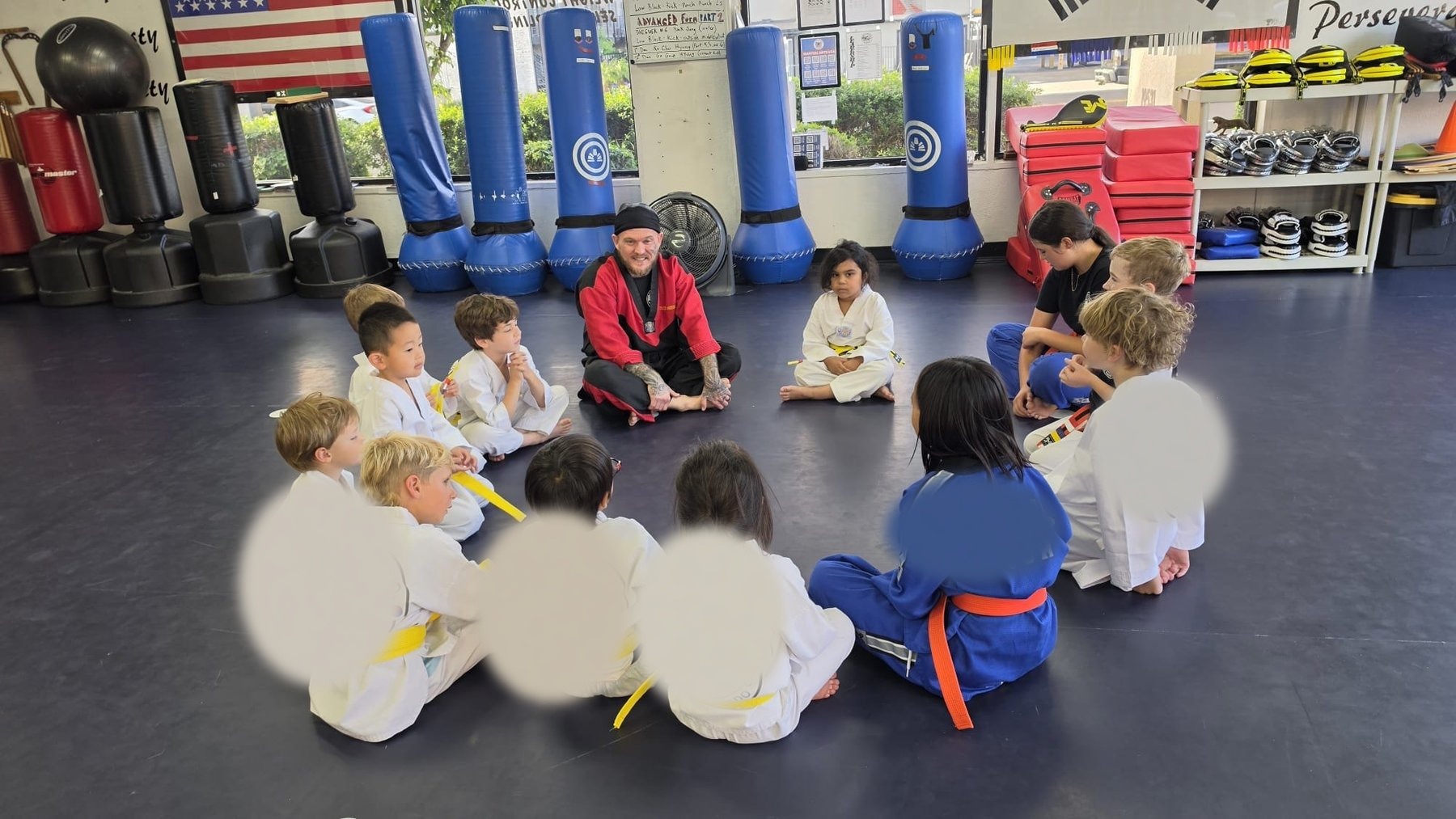
I told a parent recently: if you were designing the ideal way to build a strong, capable young athlete from scratch, this is exactly how you'd do it. That sounds like a big claim. It isn't — it's just how child development works.
Kids who start martial arts between roughly four and eight years old get something that genuinely can't be recreated later: simultaneous development of the nervous system, the musculoskeletal system, and the discipline framework that governs how they approach hard things. Their neural pathways are forming at the same time their coordination is developing at the same time their discipline is being built. All three grow together and reinforce each other in real time.
An adult who starts training later has to build each of those systems separately — usually while fighting against years of poor movement patterns, tight hips, and habits that are hard to unlearn. A kid builds all three at once, simply because the systems are still under construction.
Here's the part most parents don't realize. When a child trains consistently from around age five through puberty, by the time their body starts producing the hormones that build real strength and muscle mass, the neural pathways are already locked in. The brain-to-body connection is established. The muscle memory runs deep. The discipline is a habit, not something being forced on them.
So when the hormonal growth spurt actually arrives and the body suddenly has real strength to work with, that strength has somewhere to go — a framework already built and ready to receive it. The result looks like natural talent from the outside. It's really just good timing plus years of consistent groundwork.
Your child doesn't need to be a natural athlete to benefit from starting early. Honestly, the kids who benefit most are often the ones who start with the least natural coordination, because they build every single skill from scratch, with correct form, under real instruction — instead of relying on raw ability that eventually plateaus.
The conditioning is the training. The stances are the training. The counting, the discipline, the respect for instructors and training partners — all of it is training, and it compounds quietly over years into something that looks, from the outside, extraordinary.
Start them young. Build the framework while it's still forming. Let the body catch up to what the brain and the discipline have already learned. That's the whole approach — no shortcuts, just the right order at the right age.
We run programs specifically built around this developmental window — come see a kids' class in person and watch how it actually works.